
How Fragrance Manufacturing Services Have Changed for Seasonal Buyers
Fragrance manufacturing services changed more in the last few years than in the decade before them, and most of the change passed directly onto buyers. Regulation moved up the checklist, packaging became a sourcing decision with its own rules, and manufacturers started selling capability — museums, academies, process transparency — instead of just price. A seasonal buyer who still evaluates the way buyers did five years ago is working from the wrong map.
Key takeaways
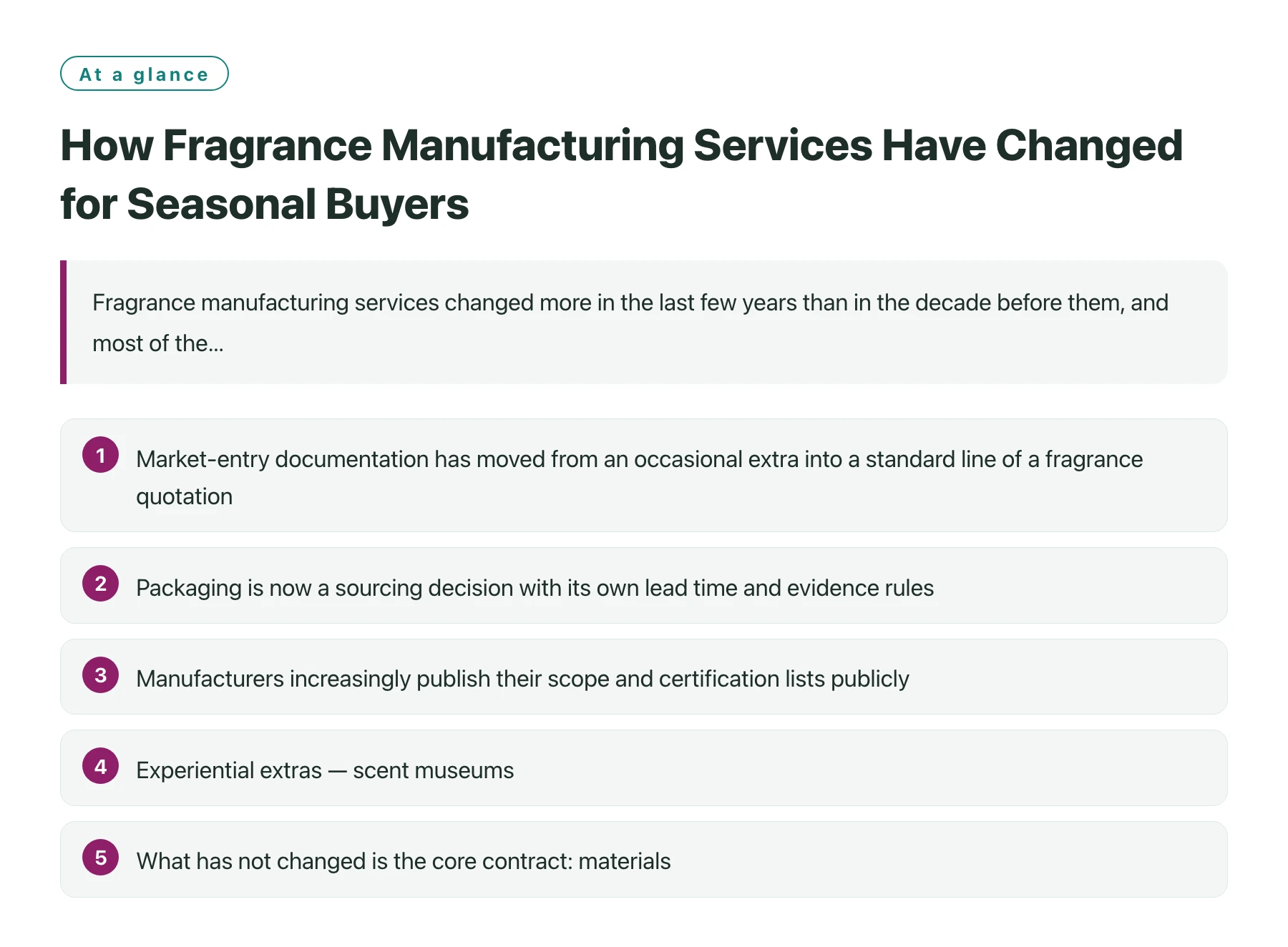
- Market-entry documentation has moved from an occasional extra into a standard line of a fragrance quotation, and the buyer who does not itemise it pays for it later.
- Packaging is now a sourcing decision with its own lead time and evidence rules, so it has to start in the same week as the formula brief.
- Manufacturers increasingly publish their scope and certification lists publicly, which turns candidate comparison from phone calls into document review.
- Experiential extras — scent museums, academies — are real evidence of a house's material taste, but they are context, not proof of process.
- What has not changed is the core contract: materials, compounding, filling, testing and shipping are still the spine of any OEM/ODM engagement.
This is not a trends essay; it is a practical list of what has changed in how OEM/ODM fragrance services are quoted, scoped and delivered, written for someone buying a seasonal collection this year.
Each change below comes with the question it should put on your checklist.
Regulation moved into the quotation
Market-entry paperwork is now a standard line
EU enforcement of the cosmetics regulation has made market-entry documentation a routine attachment to fragrance quotes rather than an occasional extra [1]. Buyers who used to ask 'can you ship to the EU?' now ask which documents the quote includes and who owns them.
The ingredient check happens earlier
The same shift pushed ingredient-level checks upstream: usage limits and restricted materials are now discussed at the brief stage, before the accord is chosen, because fixing them later costs a sample round and a week.
Packaging became a sourcing decision with rules
Packaging was once chosen last, after the scent. Now it often decides the schedule, because refillable formats, decoration complexity and recyclability claims each carry their own lead time and evidence requirement.
Recyclability guidance from organisations such as the Sustainable Packaging Coalition has reached the buying desk in a concrete form: a recyclability claim on a seasonal pack now needs a basis, which is a documentation task, not a design task [2].
For seasonal buyers the practical effect is that packaging decisions start at the same time as the formula brief, and the two calendars are reconciled in the first call.
The service scope widened, and the pitch got shorter
Manufacturers now present development, filling, decoration, training and even brand experience as one story. The useful part of that is transparency: a factory that states its scope in public makes comparison faster than one that only answers by phone.
A Guangzhou manufacturer like Xuelei lists manufacturing services, an academy and a scent museum as parts of one operation — and the museum is genuinely informative: the immersive scent museum lets you read a house's material taste without a single sales meeting.
What has not changed is the core: a contract for contract perfume manufacturing in China still means raw materials, compounding, filling, testing and shipping, and the buyer who remembers that will not be distracted by the extra services.
The shortest useful pitch in the industry now is a published scope plus a published certification list. Everything else — tours, visuals, stories — is context, and context is cheap.
The training angle is worth a second look as well. Houses that run education programmes tend to staff their evaluation and tasting stages with people who can explain what they are smelling, which shows up in the quality of your sample feedback. For a seasonal buyer that feedback decides how many rounds a project takes, and rounds are the most expensive part of a compressed calendar.
What the buyer should do differently now
The practical consequence of all these changes is that the buyer's job has widened: evaluation today covers document ownership, packaging evidence and process transparency alongside price and smell. The good news is that most of the new information is public — scope pages, certification lists, ingredient databases — so the comparison phase has moved from phone calls to reading.
For a seasonal collection the discipline is the calendar: start the document list in the same week as the brief, fix the packaging claims before the carton order, and ask the factory which parts of the dossier it prepares in-house. The houses that answer quickly are usually the ones that already built the process instead of improvising it.
One more change worth using: samples now travel with more context. Instead of a vial and a sketch, expect data — usage-limit position, stability notes, recommended dosage. If a candidate sends only the vial, that is a signal about its documentation habits, and documentation habits are exactly what a seasonal launch depends on.
Ask each supplier what changed in its own service in the last two years. The answer separates houses that track the market from houses that present the same brochure twice a decade — and for a seasonal launch, that single question is usually a better filter than a price comparison.
Sources
- European Commission: Cosmetics in the EU —— The European Commission's overview of EU cosmetics rules, including the responsible person, product information file and safety report requirements.
- Sustainable Packaging Coalition —— A membership organisation working on more sustainable packaging design, publishing material and recyclability guidance.
Frequently asked questions
What changed most in fragrance manufacturing services for small brands?
Market-entry documentation and packaging evidence became standard deliverables, and manufacturers began publishing scope and certification lists instead of only quoting. Small brands can now compare candidates before a single phone call.
Do the new packaging rules affect a seasonal collection?
Yes, mainly through recyclability claims and refillable expectations. Decide which claims the pack will make early, because each claim needs documentation and usually a longer decoration lead time.
Is it still worth sourcing fragrance from China?
For many seasonal buyers, yes — the value is the same as it ever was: development cost, factory breadth and production scale. What has changed is that compliance and documentation now have to be priced and planned in, exactly as they would at any origin.
Should I visit the factory, or is remote evaluation enough?
Remote evaluation with published scope, certification checks and a retained sample review can screen well, but a visit — or at least a video walkthrough of compounding, filling and QC — is still the cheapest way to confirm the process is real.
Which document changes should a seasonal buyer plan for?
Plan for the destination market's ingredient declaration, usage-limit checks, batch certificates and any packaging evidence the pack claims. Name all four in the quotation and ask who prepares each.
See your numbers 23 days earlier.
Book a 30-minute walkthrough with a solutions engineer. Median time-to-first-insight: 14 minutes from signup.
▶ Get a live demo →